


Patient-reported experience of intravenous sedation in the oral surgery department at Dublin Dental University Hospital
24 Nov 2026
Estimated read time:
11 min read
Dr Ananya Nagpal, runner up of the MPS Foundation 2026 Ireland Dental Research Competition, shares her work with Dr Kamila Marcinczak, Dr Mary Clarke and Dr Katy Martin.

Summary
This Quality Improvement Project (QIP) evaluated patient-reported experience of intravenous sedation (IVS) in the Oral Surgery Department at Dublin Dental Hospital. National guidance from the Inter-collegiate Advisory Committee for Sedation in Dentistry (IACSD,2020) and the Irish Dental Council (IDC, 2023) was used to define benchmark standards, including 100% patient-reported understanding of risks and consent processes, and ≥90% overall satisfaction.
A prospective, anonymous post-procedure survey was distributed over a two-month period. A total of 37 responses were received. Results demonstrated overall high levels of satisfaction with the service. Approximately 90% reported feeling involved in the decision-making process regarding sedation, while more than 95% reported understanding the risks and benefits of sedation. Pain and anxiety management were also rated positively, with 100% and 95% of respondents, respectively reporting that these aspects of care were managed well. All respondents reported that they would recommend the service to family or friends, and more than 70% rated their overall experience as 10/10. Benchmarks requiring 100% compliance were not fully achieved but were closely approached.
Targeted interventions were planned, including revision of sedation-specific consent documentation, simplification of aftercare leaflets, along with departmental feedback and reflection. This QIP highlights that patient satisfaction extends beyond clinical and pharmacological management alone. It equally requires the need for excellent communication, information provision, service organisation and governance processes. Re-audit is planned to assess the impact of the implemented changes and determine whether the identified standards are achieved.
Introduction
Dental anxiety remains one of the most significant barriers to accessing dental care. One in five patients attending the dentist experiences some degree of dental anxiety.1 Poorly managed anxiety and pain not only affect patient experience but may also influence treatment compliance, and the ability of patients to engage in informed decision-making. Pain and anxiety can be effectively managed in many ways, including the provision of behavioural support, local anaesthesia, conscious sedation and general anaesthesia.
One of the techniques used to manage patient anxiety is through the use of conscious sedation. Conscious sedation is defined by the Irish Dental Council as ‘a technique in which the use of a drug produces a state of depression of the central nervous system enabling treatment to be carried out, during which verbal contact is maintained’.2 This can be achieved by the administration of drugs intravenously or by use of inhalation sedation. Intravenous sedation (IVS), commonly using midazolam, is an important technique for management of anxiety in adult patients undergoing oral surgical procedures.
This QIP aims to evaluate patient-reported experience measures (PREMs) to identify areas of improvement in patient safety, communication, and service delivery. In healthcare, there has been a shift away from a disease-centred approach towards a patient-centred approach, and this has prompted the widespread use of PREMs. PREMs are particularly useful in IV sedation services in oral surgery as the patient's experience may be influenced by anxiety, communication, trust, perceived safety and confidence in the care provided. Measuring patient satisfaction using PREMs is essential as it is a key determinant of patients’ compliance with advice3 as well as an indicator of treatment quality as per Zimmerman, 1999.4
The use of PREMs provides an opportunity to identify aspects of care that may not be captured by clinical outcomes alone. Evaluating these experiences can therefore support patient-centred care and inform targeted service improvements.
Aims/objectives
The aim of our quality improvement project is to:
- Evaluate patient-reported experience of IVS in the Oral Surgery Department.
- Benchmark outcomes against IACSD(2020) and Irish Dental Council (2023) standards.
- Identify areas for improvement in communication, consent, anxiety management and postoperative information provision.
- Inform service development and identify governance issues that may contribute to patient safety and potential medico-legal risk.
Benchmarks/standard
Audit standards were derived from IACSD (2020)5 and Irish Dental Council (2023) guidance:
- 100% of patients should report they were adequately informed regarding risks and benefits of sedation and post-operative care.
- 100% should report satisfactory consent and decision-making processes.
- ≥90% overall satisfaction rate, and willingness to recommend the service. These standards were chosen in recognition of the high governance threshold required for sedation services.
Methods and materials
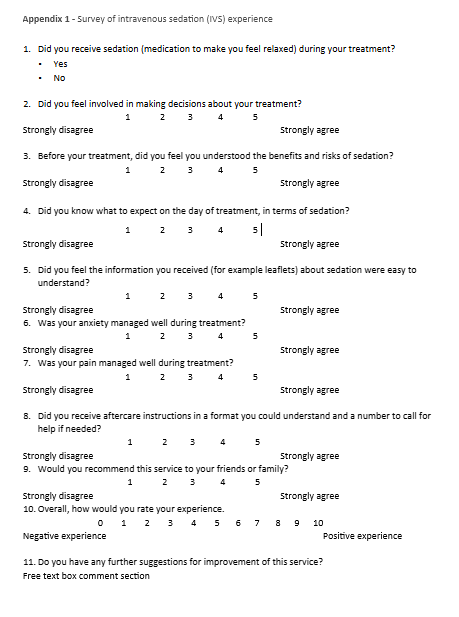
The quality improvement project was a prospective evaluation of the provision of IVS service to patients attending the Oral Surgery Department at Dublin Dental University Hospital. This was carried out using an anonymous, post-procedure survey with a Likert-scale design via Google Forms. The survey was distributed to all patients undergoing IVS over a period of two months. It consists of 11 questions addressing key aspects of patient experience including consent and decision-making, pre- and post-sedation information, anxiety and pain control, overall satisfaction and likelihood of recommending the service to family and friends.
Questions 2–9 used a five-point Likert scale ranging from strongly disagree to strongly agree. Overall experience was assessed using a numerical rating scale from 0 to 10. A free-text question was included to allow patients to identify additional areas of concern or suggestions for service improvement.
A two-week pilot phase was conducted to test the clarity and validity of the questions. Following the pilot phase, adjustments were made to the survey before full rollout.
To maximise accessibility, the questionnaire was made available in both digital and paper formats. Patients could access the electronic questionnaire using a QR code attached to the postoperative information leaflet. A text-message reminder containing a link to the questionnaire was sent one week following treatment. A postal questionnaire with a stamped return envelope was also available for patients without digital access. This multimodal approach was intended to improve accessibility and encourage participation from patients with different levels of digital access.
Results
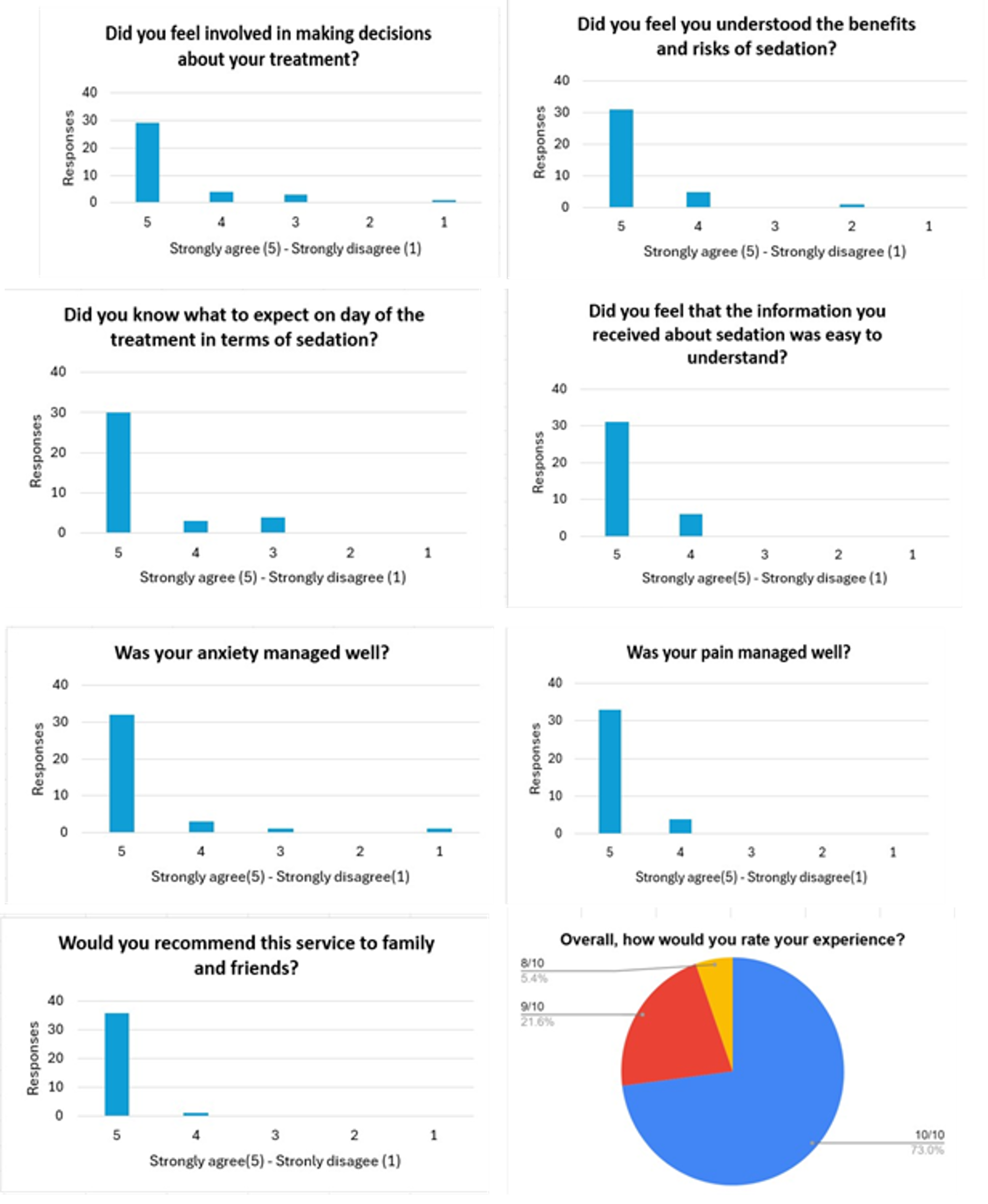
All responses were collected anonymously, exported to Microsoft Excel for analysis, and reported in aggregate. A total of 37 responses (n=37) were received and included in the analysis. Overall, the findings demonstrated a high level of patient satisfaction and positive experiences with the sedation service. Approximately 90% of patients reported feeling involved in decisions regarding their sedation and treatment. More than 95% of respondents reported that they understood the risks and benefits of sedation and were satisfied with the information provided through the pre- and post-sedation information leaflets.
More than 90% of patients reported that they knew what to expect on the day of sedation, suggesting that the information provided before treatment was generally effective in preparing patients for their appointment.
Pain management was rated particularly positively, with 100% of respondents reporting that their pain was managed well. Anxiety management was also viewed favourably, with 95% of patients reporting that their anxiety was managed well. Overall satisfaction with the service was very high. 100% of respondents stated that they would recommend the service to family or friends, while more than 70% rated their overall experience as 10/10.
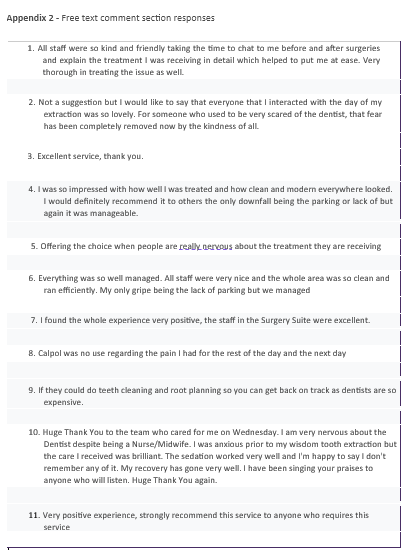
Analysis of the free-text comments identified several recurring themes. Patients overwhelmingly praised the kindness, professionalism and supportive approach of staff, reinforcing the positive quantitative findings. However, respondents also identified several areas for improvement. These included unclear post-operative instructions, particularly regarding post-operative analgesia, and others mentioned lack of parking facilities. Some respondents also suggested expanding the service to include routine non-surgical dental procedures under sedation.
Overall, the qualitative feedback complemented the quantitative findings by demonstrating high levels of satisfaction while identifying specific communication and service-delivery issues that could be addressed through targeted improvement measures.
Discussion
This quality improvement project evaluated patient-reported experience of IVS within the Oral Surgery Department at Dublin Dental University Hospital. Overall, the findings were encouraging, with high levels of reported satisfaction across the majority of measures.
Our QIP shows that most benchmark standards were closely approached. Approximately 90% of respondents reported feeling involved in decisions regarding their sedation and treatment, while more than 95% reported understanding the risks and benefits of sedation and being satisfied with the information provided. Pain and anxiety management were also rated positively, with 100% and 95% of respondents, respectively, reporting that these aspects of their care were managed well.
Of particular interest was the difference between willingness to recommend the service and the highest overall experience rating. Although 100% of respondents reported that they would recommend the service to family or friends, only more than 70% rated their overall experience as 10/10. This suggests that willingness to recommend a service may capture a broader perception of patient satisfaction. It also highlights the importance of considering the patient's complete experience rather than focusing solely on the technical success of the procedure.
As discussed by Newsome and Wright (1999)6, five issues directly relate to patient satisfaction including technical competence, interpersonal factors, convenience, costs and facilities. The free-text responses in this QIP support this broader understanding of patient experience. Patients frequently highlighted staff kindness, reassurance and professionalism as strengths of the service. Conversely, unclear postoperative instructions and lack of parking were identified as areas that could be improved.
The findings therefore suggest that opportunities for improvement extend beyond the clinical management of sedation itself. In particular, postoperative instructions should be sufficiently clear and accessible to patients following treatment. This has informed the proposed revision of our postoperative information leaflet.
The audit also identified an opportunity to strengthen the consent process. Although the majority of respondents reported understanding the risks and benefits of sedation and feeling involved in decision-making, the 100% standard was not achieved. This supports the introduction of a more structured approach to sedation-specific consent and documentation.
Limitations
This quality improvement project has several limitations. First, the sample size was relatively small, with 37 responses collected over a two-month period. This limits the generalisability of the findings, and future audit cycles should aim for a larger sample size to achieve a more representative sample.
Second, the project relied on voluntary patient responses and may therefore be subject to response bias. Patients with particularly positive or negative experiences may have been more likely to complete the questionnaire, and the experiences of non-respondents may differ from those captured in the study.
Improvement actions
Following the analysis of results, some improvement actions planned for change include:
- Revision of the post-operative aftercare leaflet to simplify language and improve clarity, with clear oral hygiene instructions and visual formatting improvements to support accessibility.
- Revision of the consent form to include sedation-specific risks in a structured format.
- To promote consistent and comprehensive discussion about the need for sedation to support informed decision-making at the oral surgery assessment visit.
- Departmental feedback session with presentation of findings to promote reflective practice and promote governance standards.
Impact on patient safety and risk mitigation
This QIP reinforces that patient experience is shaped not only by high clinical standards, but also must be accompanied by excellent communication, documentation and structured consent practices. These may mitigate medicolegal risk and enable outstanding clinical outcomes. The project strengthens governance oversight of sedation services and promotes a proactive safety culture.
Conclusion
This quality improvement project demonstrated a predominantly positive patient-reported experience of intravenous sedation within the Oral Surgery Department at Dublin Dental University Hospital. Patients reported positive experiences of pain and anxiety management, communication and staff support, while free-text responses identified postoperative information and aspects of service organisation as areas for improvement.
Although most predefined standards were closely approached, the 100% standards relating to understanding of sedation risks and benefits and involvement in decision-making were not achieved. These findings highlight opportunities to strengthen sedation-specific consent processes and communication with patients.
Targeted improvement measures, including revision of the consent documentation, simplification of postoperative information and departmental feedback, have been identified in response to the findings. Re-audit is planned to assess whether the interventions result in measurable improvement and sustained compliance with the predefined standards. To conclude, this project demonstrates the value of incorporating patient-reported experience into the ongoing quality improvement and governance of intravenous sedation services.
References
- Brady P, Dickinson C, Whelton H. Dental anxiety prevalence and surgery environment factors: a questionnaire-based survey of attenders in Ireland. SAAD Digest. 2012;28:13–22.
- Dental Council. Code of Practice Regarding Sedation in Dentistry. Dublin: Dental Council; 2023.
- Ley P. Communicating with Patients: Improving Communication, Satisfaction and Compliance. London: Chapman and Hall; 1988.
- Zimmerman R. The dental appointment and patient behaviour: differences in patient and practitioner preferences, patient satisfaction, and adherence. Medical Care. 1988;26:403–414.
- Intercollegiate Advisory Committee for Sedation in Dentistry (IACSD). Standards for Conscious Sedation in the Provision of Dental Care. Version 1.1. 2020.
- Newsome PRH, Wright GH. A review of patient satisfaction: 1. Concepts of satisfaction. British Dental Journal. 1999;186:161–165.
- Newsome PRH, Wright GH. A review of patient satisfaction: 2. Dental patient satisfaction: an appraisal of recent literature. British Dental Journal. 1999;186:166– 170.
Appendix