



The ABCDE of AI
24 Nov 2026
Estimated read time:
4
min read
Raj Rattan, Global Adviser at Dental Protection, shares prompts to consider before relying on an AI tool.

ABCDE: accountability, bias, code, data and explainability
Artificial intelligence (AI) is rapidly transforming healthcare, and its adoption raises complex ethical questions. This article explores the ethical dimensions of AI in dentistry by applying the framework proposed by Beauchamp and Childress in 1979, based on four principles: respect for autonomy, beneficence, non-maleficence and justice. Although developed long before the emergence of AI, these principles remain highly relevant and provide a framework for its ethical adoption.
Applying the four principles to AI
A 2025 scoping review by Gorelik and colleagues, examining 227 publications, found that the ethical issues associated with healthcare AI could be mapped onto these established principles. This supports their continued relevance and serves as the rationale for adopting ‘principlism’ as the framework for this discussion.
Autonomy
Respect for autonomy requires that patients can make informed decisions about their care, including when AI contributes to clinical assessment or treatment recommendations. This obliges clinicians to be transparent about AI's role. The ethical requirement is not necessarily to explain how an algorithm works, but to ensure that its use does not compromise consent or clinical judgement. Where the AI operates as a 'black box', its recommendation may be difficult to interpret, making clinical judgement all the more important.
Beneficence
The principle of beneficence places the patient's welfare at the centre of decisions about the use of AI. Potential benefits include improved diagnostic accuracy, earlier disease detection and greater clinical efficiency.
But a system that performs well is not necessarily one that helps patients. Van de Sande and colleagues (2024) found that almost half of the AI trials (in medicine) they reviewed that performed well on statistical measures did not improve patient outcomes.
Non-maleficence
Non-maleficence, often expressed as primum non nocere ('first, do no harm'), requires us to recognise and mitigate AI-related risks. AI systems therefore require clinical validation, ongoing monitoring, and reporting of adverse events and developers and manufacturers, amongst others, share an ethical duty to minimise harm. At present, however, professional and legal responsibility for clinical decisions rests largely with the clinician.
Justice
For Beauchamp and Childress, justice in healthcare is primarily distributive, concerned with the 'fair, equitable, and appropriate distribution' of benefits and burdens. In the context of AI, this raises two concerns. The first is bias: AI trained on unrepresentative data may perform less well for some patient groups. The second is access. The medical practitioner Julian Tudor Hart observed that 'the availability of good medical care tends to vary inversely with the need for it in the population served'. In other words, those who most need care are often the least likely to receive it, and there is little reason to expect AI to be an exception. The World Health Organisation warns that AI 'can reinforce and exacerbate' existing disparities and calls for its use to be equitable 'irrespective of … income'.
A fifth principle?
Some ethicists argue that the four principles are not enough for AI. Luciano Floridi and Josh Cowls proposed adding a fifth, explicability, which combines intelligibility (how does it work?) and accountability (who is responsible when it goes wrong?). Regulators and courts will not hold an algorithm to account. They will hold the clinician to account.
Conclusion
The principles of biomedical ethics were established long before the arrival of AI, yet they have lost none of their relevance. Figure 1 translates them, together with explicability, into fifteen questions, grouped as the ABCDE of AI, that clinicians can ask before relying on an AI tool. None of these questions can be answered by the algorithm itself. They are prompts for reflection, not a checklist to be completed.
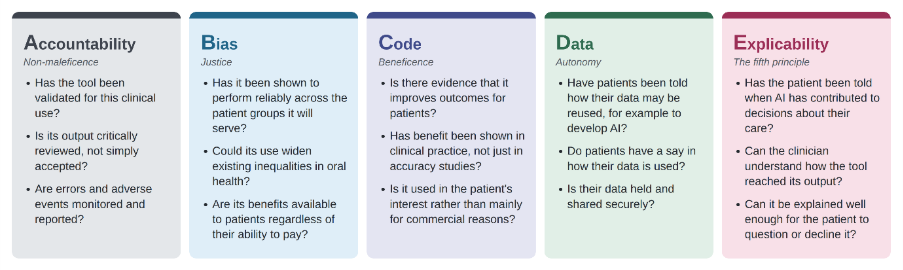
Figure 1: The ABCDE of AI
References
Beauchamp TL, Childress JF. Principles of Biomedical Ethics. 8th ed. Oxford: Oxford University Press, 2019.
Gorelik AJ, Li M, Hahne J, Wang J, Ren Y, Yang L, et al. Ethics of AI in healthcare: a scoping review demonstrating applicability of a foundational framework. Front Digit Health. 2025;7:1662642.
Floridi L, Cowls J. A unified framework of five principles for AI in society. Harvard Data Science Review 2019; 1(1).
Schwendicke F, Samek W, Krois J. Artificial intelligence in dentistry: chances and challenges. J Dent Res 2020; 99: 769–774.
van de Sande D, Chung EFF, Oosterhoff JHF, van Bommel J, Gommers D, van Genderen ME. To warrant clinical adoption AI models require a multi-faceted implementation evaluation. npj Digital Medicine 2024; 7: 58.
World Health Organization. Ethics and governance of artificial intelligence for health: WHO guidance. Geneva: World Health Organization, 2021.
Rokhshad R, Ducret M, Chaurasia A et al. Ethical considerations on artificial intelligence in dentistry: a framework and checklist. J Dent 2023; 135: 104593.
Hart J T. The inverse care law. Lancet 1971; 297: 405–412.