


Pressure, complaints and wellness in dentistry
25 Jun 2026
Estimated read time:
8 min read
Dr David Crum, Director of Indemnity Services NZDA, shares an evidence-led look at stress, complaints, and mental wellbeing in dentistry, and how practitioners can better protect themselves.
Dentists are judged, by their patients, by regulators, at times by their colleagues and, probably most of all, by themselves.
Amongst the background sits the real ‘kicker’. We (dentists) are self-reliant, strongly exacting, and often competitive but, we can also be quick to feel judged and cope poorly with such feelings.
I will explore this a little further.
The recent NZDA Wellness Survey (over five hundred participants),1 portrayed a number of ‘low’ lights. The standout findings among them were:
- 69% of dentists responded as being ‘very’ or ‘extremely’ affected by negative feedback or formal complaint
- Over 50% of dentists surveyed rated as being ‘very’ or ‘extremely’ affected by ‘how much the pressure of maintaining a successful image affects their practise of dentistry.’
It seems logical that, if we are very affected by negative feedback and very concerned about maintaining a successful image, then it is not surprising we don’t easily tell others of professional difficulties and/or patient issues we are facing.
We stay in our own thoughts and that is not ‘wellness’ wise.
Perhaps, in part, there is also an added overlay. Dentists are coursing through a work life unlike many others; a singular role / job across our whole working life span and, there are dentists who feel trapped by that. They live the quiet ‘ground hog’ day.
One of the focal points of the research was the impact of complaints on the wellbeing of dentists. Through both the quantitative and qualitative research, the NZ Dental Council process was repeatedly referred to as one of the most stressful experiences in a dentist’s career.
In turn, it is logical to consider this is why dentists appear increasingly nervous about making mistakes and undertaking work for difficult patients.
Further, the survey showed that when asked, an alarming number of dentists had a degree of mental health challenges with more than half of participants reporting, that for several days or more in the previous two weeks, they:
- Expressed feeling down, depressed or hopeless for several days or more.
- Reported feeling nervous, anxious or on edge.
- Hadbeen moderately to extremely stressed by staffing issues, and/or appointment book issues.
There is not much in all the above that encourages or portrays wellness. In fact, the researchers concluded that in their view, these statistics are alarming and, paint a picture of a profession that is struggling.
The complaint and the downward spiral
It is said that dentists interpret a patient complaint (or one from a colleague) as a threat to three core domains. Hopcraft describes them as: livelihood, reputation and identity.2 A complaint can feel like a direct attack on your competence and integrity.
There is the initial shock, the racing heartbeat, then disbelief, maybe fear and perhaps anger or shame but, the real psychological toll often comes from the duration of the resultant process. Regulatory processes can stretch for months and even years. During that time, uncertainty becomes chronic. There are circular and even multiple pathways (HDC and DCNZ) you are headed down – it ‘shadows’ you and prolonged activation of the stress response can lead to persistent anxiety symptoms, depressive features such as low mood or hopelessness, and social withdrawal.
At Dental Protection we see colleagues move into defensive clinical practice and at times also a spiral of emotional detachment from patients, becoming less confident, more cautious, less joyful.
In New Zealand, Dental Protection case officers manage just under 500 cases per year and when you look across that span, it is clear individual practitioners find that complaints can be hugely impactful either in isolation, or as an additive to other negative elements within their practise of dentistry, business, or their broader life.
Small complaints can be the ‘straw that breaks the camel’s back’, heavily impacting practioners’ wellness and serious complaints often are.
Preservation of performance
As a sidenote, but of importance, a recent Dental Protection webinar3 described ‘preservation of performance’ as part of the unwellness picture. Certainly, in the more serious cases, particularly those involving health issues, we definitely assist colleagues who have preserved their performance at work, while everything else has suffered. Amongst the ‘everything else’ being - staff, the practice environment, and the dentist’s family. The increased occurrence of drug and alcohol issues, marriage and relationship breakdown can also become entwined in the picture. Issues with alcohol being relatively common.
The preservation of performance is illustrated (see graph) as an additive to the Yerkes-Dodson curve which measures performance in an environment of increasing pressure. 4
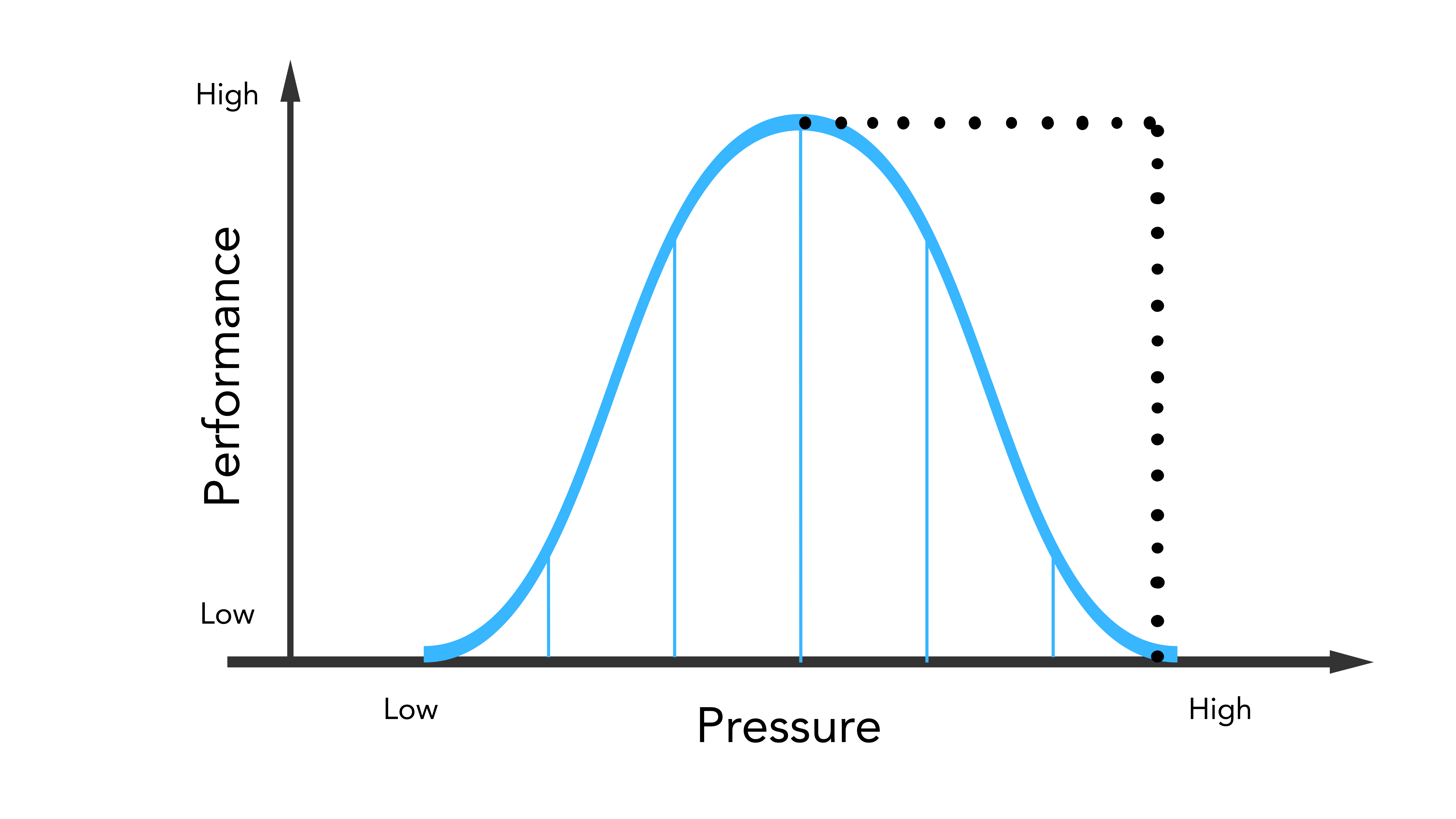
The Yerkes-Dodson Curve first described by R M Yerkes and J Dodson ‘too stressed to be productive? – or not stressed enough?’ Harvard Business Review
The bell-shaped curve showing the relationship of increased pressure leading to increased performance to a maximum and then, to the point where you move past best performance, into performance decline.
What we see (quite often) is the preservation of work performance (dotted line), high performance at work is maintained, an event (e.g. complaint) occurs and the practitioner ‘falls off the cliff’.
As you consider this – are you on the normal curve and, if so where or are you on the extended line?
The shadow of mental ‘replay’
Without doubt, reflection is useful to improvement, but it needs to be time-limited and purposeful. 2
In using the word ‘shadow’ I believe ‘mental replay’ can become one of the distressing aspects of complaints. Dentists relay to me, perhaps because it is in our nature, along with the worry of not being seen as good, that after receiving a complaint they revisit every detail of the appointment, scrutinising wording, tone, or clinical decisions. Some hit a cycle of ‘mental replay’, repeatedly; ruminating, where thoughts become negative and repetitive.
Lengthy, circular bureaucratic complaint pathways provide the constant ‘shadow’. They give room for rumination and, these pathways/processes contribute to practitioner unwellness.
Part of a Dental Protection case manager’s role is to ‘listen that out’ with you and start to move you beyond it. It is about providing the mix of support as well as advice. Listening as well as action.
Being fearful
Like everyone else, as dentists we make mistakes within our work, there is very real nervousness about that and, the consequences of it.
The regulatory and societal changes in connection with provision of health care, and patient rights over the last 30 years, are large. We all know patients have become hugely empowered; the generality of much of it, rightly so. But without doubt, there are some extremely difficult patients and, empowered they become dangerous to a practitioner’s welfare.
Dentists form beliefs on whether the regulator (DCNZ) will act fairly, undertake a ‘right touch’ response. They probably form these views largely from their impression of the regulator’s general approach to visible issues of the time. At the time of the NZDA Wellness Survey (2023) there were recent impactful and unprecedented regulatory actions related to Covid and, also the imposition of a new Recertification regime. Part of, perhaps most of, the picture (the fear) will of course also be what dentists hear from practitioners who have been through the process.
More generally, the system (in my view) fails to reach its best, because there is no willingness from regulators to collaborate (as opposed to consult) with practitioners; to allow a collaborative voice to improve the outcomes.
The result is practitioners generally and, certainly many individually, feel like they are being treated unfairly and there is fear of the process. Individual accounts when relayed, whilst arguably somewhat coloured by the dentist who went through the ‘it’, have common themes of undue length of time the process takes, the invasiveness of it, the unkind and disempowering formality. These things don’t support practitioner wellness.
Connectiveness… it is connectiveness that helps keep us well
So much of wellness can be about ‘association’… staying individually and collectively connected. During my working life there has been a change in the connection between practitioners (dentist to dentist) and between practitioners and their patients. Generally, dentists describe feeling less connected and less supported.
With respect to connection with colleagues, imposed recertification changes that lessen in-person collegial events (such as CPD) and of course, in a broader context, the upswing of online learning, has become a generational change, in how we interact. The building of reputation by online selective imaging of case material and use of social media, can create ‘strategic authenticity’ rather than ‘unfiltered reality’ and arguably, a very much ‘selective self-presentation’.5 The obvious danger is that some judge themselves negatively by what they see others present online.
Connection with our patients – over the last 30 years, our communities have also changed. Perhaps we are less likely to personally be from the community we serve, there is population diversity, mobility and patients often no longer see the same dentist over extended periods of time. In many instances patient complaints are somewhat derived from the commoditisation of dentistry. There is a changed dynamic between what patients see as dentistry/their perception of dentistry – the purchasing of a commodity rather than accessing health care. The environment is now one in which patients (and many dentists) have become more transactional. Patients are more empowered, complain more and have more pathways to do so. It is not uncommon for patients to not be certain or not even know the name of the dentist they are complaining about.
Is the answer in being good or wise?
I recently listened to one of the ‘You are not a frog’ podcasts presented by Rachel Morris titled ‘You do not have to be good’ 6. Rachel also co presented the recent Dental Protection series of webinars on the topic of burnout. She talks about the personal cost of ‘being good’, tangling ‘being good’ and ‘doing good’ with what it is to be ‘professional’ (e.g. being measured, contained and self-less) and, how it is better, to be ‘wise’. Whilst, within the podcast, there was a lot to what Rachel said, and it is better listened to directly, I feel there is a building block here for practitioners to stay well.
Being ‘good’
- Absorbing all the extra pressure without complaining
- Staying pleasant and not letting anything show
- Not being ‘weak’
versus,
being ‘wise’ (exampled by Rachel as)
- Noticing risk and asking for help
- Acting within your limits
- Correcting course early
- Admitting when you are wrong
- And repairing relationships.
There is nothing in the being ‘wise’ list that is not useful to preventing and resolving issues with colleagues, patients, within our practices and broader lives. Being wise rather than good could be part of the answer to improving wellness.
References
1. Redefining Wellbeing in the New Zealand Dentistry Profession: Research Report. Prepared for the NZDA by Revolutionaries of Wellbeing. Feb 2023.
2. The Psychological impact of Patient Complaints – The Mindful Smiles Club, Melbourne, Victoria, Australia. Matt Hopcraft – March 4, 2026
3. How to stop the slide into burnout. Rachel Morris
4. Are you too stressed to be productive? Or not stressed enough? Harvard Business Review. Francesca Gino. April 2016.
5. Online versus Offline Personality: Digital Identity Psychology. Net Psychology. Octavio Ortega Esteban. January 2025.
6. You are not a frog- You do not have to be good. You Tube Podcast. Rachel Morris. Feb 17, 2026